Saldatura manuale
What Shielding Gas for TIG Welding?
1 settembre 2022
How to choose the right shielding gas for TIG welding? Is there a gas suitable for any material that can be TIG welded?
Antti Kahri
Argon and Helium are the most common shielding gases for TIG welding
The term TIG (tungsten inert gas) welding implies that shielding gas for TIG welding must be inert, and can’t contain any active components. As such, two different gases, argon (Ar) and helium (He), can be used as main gas components. The most common shielding gas for TIG welding is pure argon because it is suitable for any type of material that can be TIG welded. Pure argon provides a stable and narrow welding arc, excellent arc ignition, and relatively low heat input and penetration. These characteristics make pure argon suitable for most TIG welding applications and typically, it is the only shielding gas that hobby welders and professional welders need.
A mixture of argon and helium with 30, 50, or 70% helium is used when welding requires high heat input. Pure helium can even be used when a particularly high heat input is required, for example, when welding thick copper material. Helium also makes the penetration profile wider and deeper. As such, a mixture of argon and helium, or even pure helium, is suited for efficient welding with greater penetration. However, arc ignition characteristics with helium are not as good as with argon and this should be taken into consideration when choosing TIG welding devices. When using pure helium, a powerful high-frequency spark and adjustable ignition parameters are very beneficial.
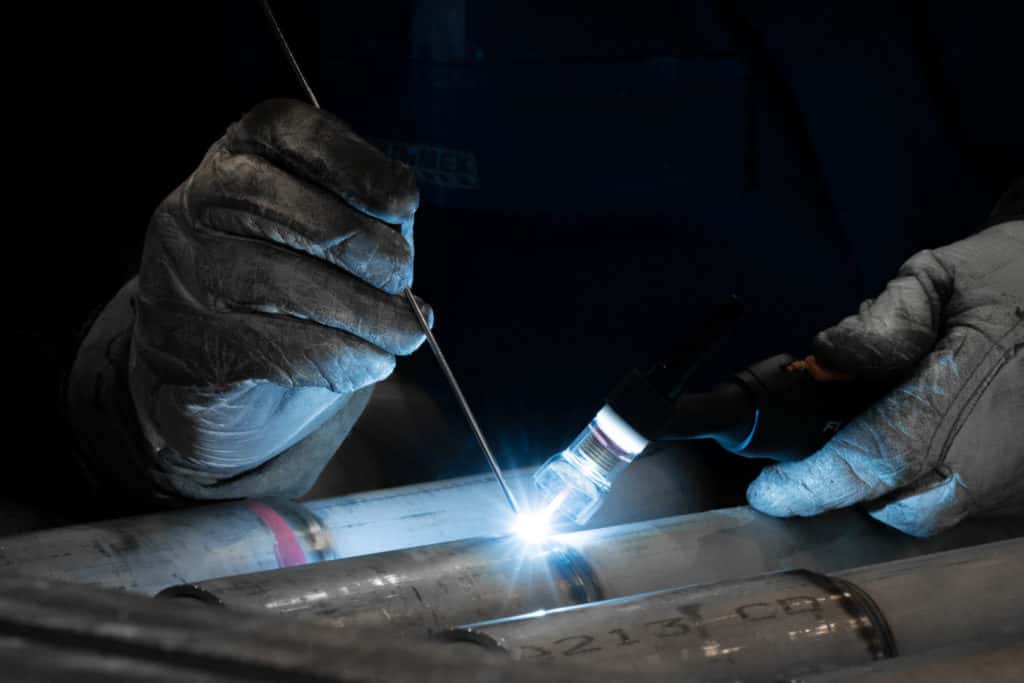
TIG welding
TIG welding can contain a mixture of argon and additive gases; hydrogen, nitrogen and nitrogen oxide
In addition to these two main components, shielding gases for TIG welding can contain:
hydrogen (H2)
nitrogen (N2)
nitrogen oxide (NO)
A small amount of hydrogen (for example 2-6 %) can be used to improve weld pool fluidity for increased penetration or a reduction reaction. In practice, when welding austenitic stainless steels, brighter weld colors can be achieved when hydrogen is used in the shielding gas. However, hydrogen must not be used with ferritic or ferritic-austenitic steels because of hydrogen embrittlement.
When welding high-alloyed austenitic steels or super-duplex steels, a nitrogen loss reaction is quite common. When using filler wire, this reaction is taken into account by using wire with the ideal chemical composition. TIG welding of high-alloyed steels can also be done without filler wire and nitrogen loss can be compensated for by using a small amount of nitrogen (approx. 1.8 %) in the shielding gas. The purpose of nitrogen oxide is to improve the working environment by removing ozone. In some cases, it can also improve arc stability. The typical amount of nitrogen oxide is quite small, (e.g. 0.03 %).
The quality of shielding gas flow matters
A shielding gas flow has a significant effect on weld quality. A highly turbulent flow offers poor shielding and elevated gas consumption while a smooth laminar gas flow provides excellent weld pool shielding and economic gas usage.
A highly turbulent shielding gas flow with a market standard gas lens versus a smooth laminar gas flow with Kemppi gas lens kit.
Read more about Kemppi consumables and get to know >>> the Flexlite TX TIG torch range.

Antti Kahri
Antti Kahri
A respected expert in the field of welding, who tragically passed away in early June 2025 while pursuing his passion on a fly fishing trip. As a Welding Engineer on Kemppi Oy’s Welding Team, he held the prestigious International Welding Engineer (IWE) qualification and brought over a decade of experience to developing advanced welding characteristics for TIG, MIG/MAG, and MMA welding machines, including the renowned X8 MIG Welder and MasterTig. Known for his deep expertise and commitment to welding excellence, he was passionate about enhancing the quality and efficiency of welding through user-friendly innovations. His legacy lives on in the technology he helped shape and in the inspiration he offered to colleagues and the wider welding community.
Prodotti correlati
Famiglia di prodotti
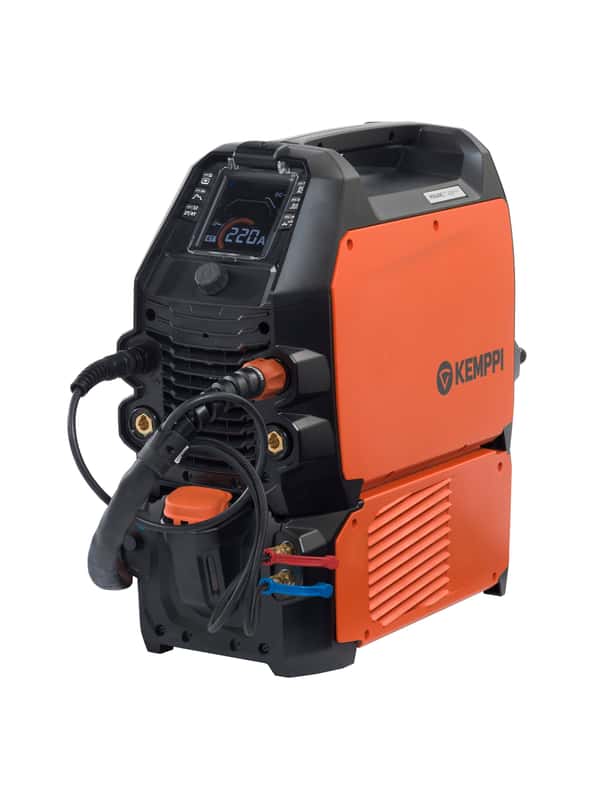
Minarc T è una saldatrice portatile multitensione che consente di eseguire saldature TIG AC/DC di alta qualità e la pulizia professionale delle saldature con un'unica macchina.
Famiglia di prodotti
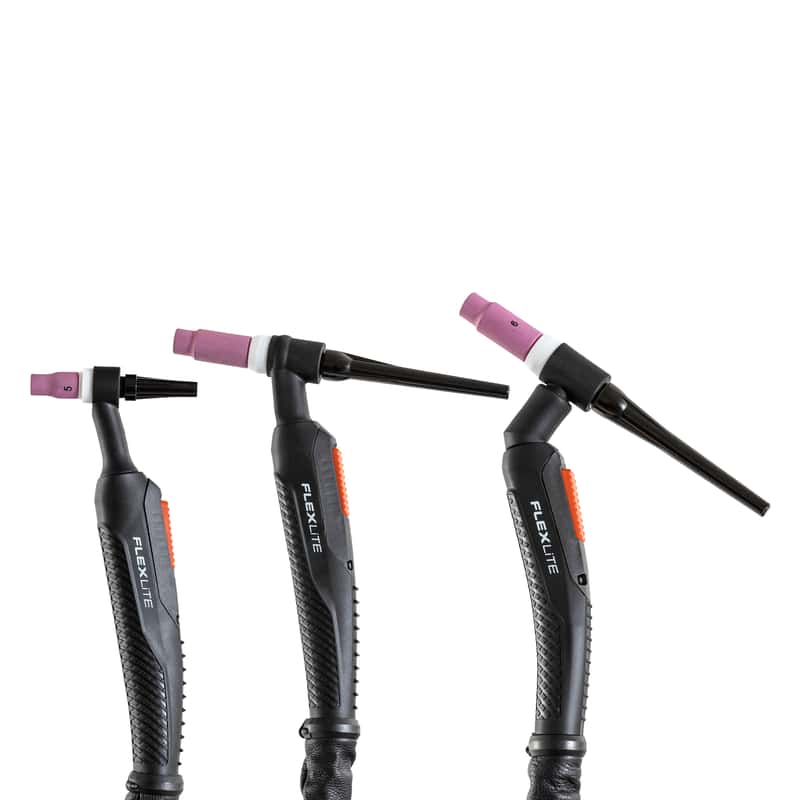
Le torce di saldatura Flexlite TX sono progettate per l'uso con l'attrezzatura di saldatura TIG Kemppi. La gamma di torce include vari modelli di lancia, offrendo eccellenti prestazioni di raffreddamento e un buon accesso a giunti difficoltosi.
Altri articoli del blog
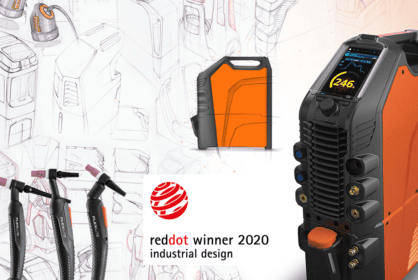
Behind the scenes - designing the new MasterTig
In welding equipment, creating a good and innovative design goes far beneath the surface. The equipment must be practical, functional, ergonomic, safe, reliable and cost-effective – while still maintaining an aesthetic appeal. Kemppi’s designers and engineers have applied user-centered design philosophy to numerous welding machines introduced since the company’s founding over 70 years ago – and most recently in the creation of the new generation MasterTig with complementary Flexlite TX TIG welding torches.
L'innovazione
The secret of a good user experience
What are the factors behind a good user experience? The recipe for the world’s best welding experiences has been developed in Kemppi R&D for over 70 years. Jussi Kapanen, Kemppi’s User Experience Manager, now reveals the ingredients.
L'innovazione
Find the right parameters for TIG welding
Successful welding relies upon a combination of parameter settings and choices.
ABC della saldatura
Come Rapid Welding e Kemppi hanno costruito una partnership che dura nel tempo
Rapid Welding collabora con Kemppi fin dalla propria fondazione, nel 1990. Roy Edwards, cofondatore e amministratore delegato, illustra i principi alla base di questa partnership lunga 36 anni: dalla scelta della soluzione di saldatura più adatta e dall'assistenza alle apparecchiature lungo tutto il loro ciclo di vita, fino alla carenza di competenze e alla ricerca del ruolo più appropriato per l'automazione e la saldatura laser.
Automazione della saldatura, Saldatura manuale, ABC della saldatura
Safety that keeps up with welders' challenges and changing risks
Welding safety has become increasingly demanding. The hazards at the arc remain constant, but modern working conditions mean exposure can accumulate over longer shifts and in tighter indoor spaces. As a result, welding PPE needs to be treated as both protection for the welder and proof of compliance. At Kemppi, welding safety PPE is designed and validated in practice through clear requirements, welder-led feedback, and verified compliance with EU PPE Regulation 2016/425, CE marking processes, and relevant EN standards.
Sicurezza, ABC della saldatura
Eurosatory 2026 e il futuro dell'industria della difesa
Eurosatory 2026 ha messo in luce un netto cambiamento nel settore della produzione moderna nel campo della difesa. Sebbene i sistemi di difesa stiano diventando sempre più digitali, interconnessi ed autonomi, la loro base rimane fisica. Dai veicoli corazzati all’artiglieria, passando per la resilienza industriale, la qualità della saldatura, le strutture in acciaio e la disciplina produttiva rimangono fondamentali per la prontezza operativa nel settore della difesa.
Digitalizzazione, L'innovazione