Welding ABC
Find the right parameters for TIG welding
March 19, 2020
Successful welding relies upon a combination of parameter settings and choices.
Antti Kahri
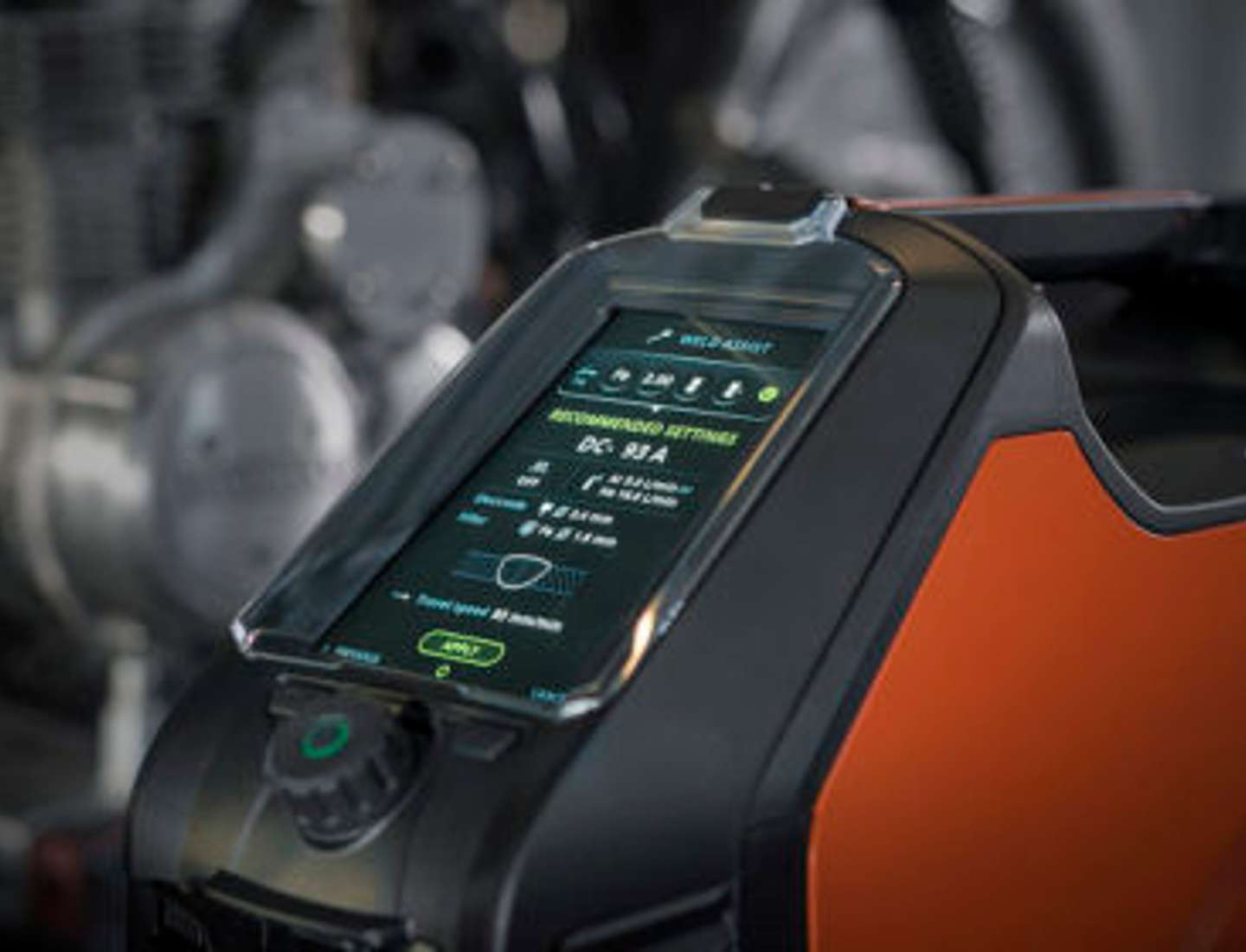
Equipment setup and parameter selection are influenced by various knowledge-based factors, including base material, joint type, welding position, and much more. While welding procedure specifications (WPS) support the decision-making process, assistive machine-embedded technologies that guide users towards the correct and appropriate welding parameter setup are now evolving throughout the industry. One example of such technologies is Weld Assist, a wizard-like function that is currently available in the graphical 7” TFT color display in Kemppi’s MasterTig product family.
How does Weld Assist work?
By following a simple step-by-step process on the panel screen, Weld Assist can determine optimal parameters for various TIG welding applications. All instructions issued by Weld Assist are based on welding tests and welding standards.
The process is based on four basic variables from the welding application at hand. The machine asks for these variables one at a time.
1. Base material Choose from steel (Fe), stainless steel (Ss) and aluminum (Al). In DC power sources, the selection is limited to steel and stainless steel.
2. Material thickness The selection range is from 0.5 mm to 10 mm. This value influences the assist function's choice of welding current and groove shape.
3. Joint type Available joint types include all commonly used joint types for sheet/plate and pipe components.
4. Welding position Choose from PA, PB, PC, PD, PE, PF and PG. As graphics are used to illustrate the selection of joint type and welding position, no specialist knowledge of abbreviations used, for example, in welding standards is required.
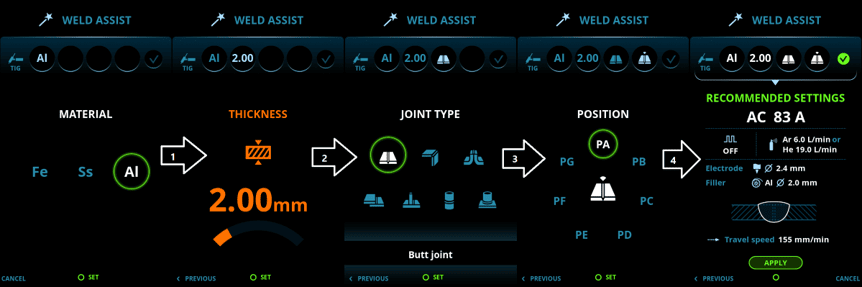
The stages of Weld Assist selection process.
Based on these four selections, Weld Assist adjusts welding current so that the molten metal behaves optimally for the welding application at hand. The screen displays suggested current type, welding current and pulse usage along with recommendations for electrode size, filler wire, gas flow, groove type, pass profile, and travel speed.
Beneficial tool for any welder
Weld Assist offers many opportunities for welding professionals. Depending on their experience level, welders can utilize such assistive welding technologies in ways that suit them best. For example, Weld Assist is an excellent tool for those learning to weld, as it helps ensure that welding standards and best welding practices are followed. Consistent use of the feature also helps form an in-depth understanding of how the variables and parameters change in different TIG welding applications.
Novice welders, on the other hand, might not know what current type should be used and or have any idea about the welding current requirements of each application. Weld Assist makes it easy to get both variables right automatically and produces satisfactory results without trial and error.
Weld Assist can also be used in demanding professional welding applications. Near-optimal settings can be achieved quickly and easily without earlier experience and without a separate learning period for when new materials, joint types and welding positions are used. As many of the variables that are required can be read from the display at a glance, producing preliminary welding procedure specifications (pWPS) is also fast and easy.
Why should I use Weld Assist?
The use of Weld Assist increases productivity and creates cost savings in many ways. Without trial and error time will be saved, and the number of test pieces will reduce. If there is no possibility for practicing with test pieces, waste and failed pieces will reduce considerably and welding quality – in terms of welding parameters – is high from the beginning.
In many cases, using Weld Assist will also make selecting the right settings faster, because key parameters like current type and related special parameters can be selected automatically with only a few pushes of a button. For a trained operator, the Weld Assist selection procedure only takes a couple of seconds to perform, while adjusting each setting separately would take considerably longer.

Antti Kahri
Antti Kahri
A respected expert in the field of welding, who tragically passed away in early June 2025 while pursuing his passion on a fly fishing trip. As a Welding Engineer on Kemppi Oy’s Welding Team, he held the prestigious International Welding Engineer (IWE) qualification and brought over a decade of experience to developing advanced welding characteristics for TIG, MIG/MAG, and MMA welding machines, including the renowned X8 MIG Welder and MasterTig. Known for his deep expertise and commitment to welding excellence, he was passionate about enhancing the quality and efficiency of welding through user-friendly innovations. His legacy lives on in the technology he helped shape and in the inspiration he offered to colleagues and the wider welding community.
More blog posts
What could you save by digitalizing your WPS?
The increasing complexity of welded products has made the development of welding procedure specifications (WPS) more time-consuming. As industries move to subcontractor and multi-site based operating models, WPS management also becomes more demanding.
Digitalization
Welding torch testing proves quality and durability
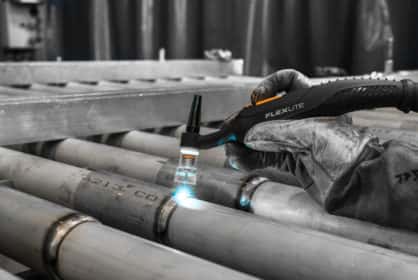
Kemppi's new Flexlite TX welding torch range offers cutting-edge features for precise TIG welding. The goal of the product development team was nothing less than to make the best TIG welding torches in the world, with compact neck design for demanding welding applications and consumables that guarantee the best welding quality and value. User experiences, tests, and measuring prove that the goal has been achieved successfully.
Innovation
MicroTack revolutionizes the tack welding of thin sheet metal
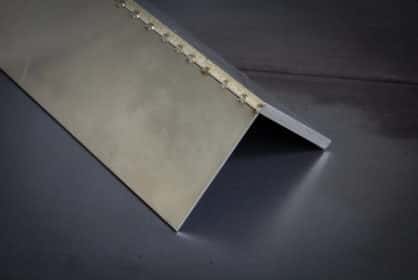
Tack welding is one of the most important work phases before welding. In tacking, the structural parts are combined with short tack welds in preparation for the actual welding. The tack welds keep the parts in the correct position in relation to each other until the welding has been done.
Innovation
How Rapid Welding and Kemppi Built a Partnership That Lasts
Rapid Welding has worked with Kemppi since the company opened in 1990. Co-founder and Managing Director Roy Edwards highlighted the principles behind that 36-year partnership, from choosing the right welding solution and supporting equipment throughout its life to addressing the skills shortage and finding the right place for automation and laser welding.
Welding automation, Manual welding, Welding ABC
Safety that keeps up with welders' challenges and changing risks
Welding safety has become increasingly demanding. The hazards at the arc remain constant, but modern working conditions mean exposure can accumulate over longer shifts and in tighter indoor spaces. As a result, welding PPE needs to be treated as both protection for the welder and proof of compliance. At Kemppi, welding safety PPE is designed and validated in practice through clear requirements, welder-led feedback, and verified compliance with EU PPE Regulation 2016/425, CE marking processes, and relevant EN standards.
Safety, Welding ABC
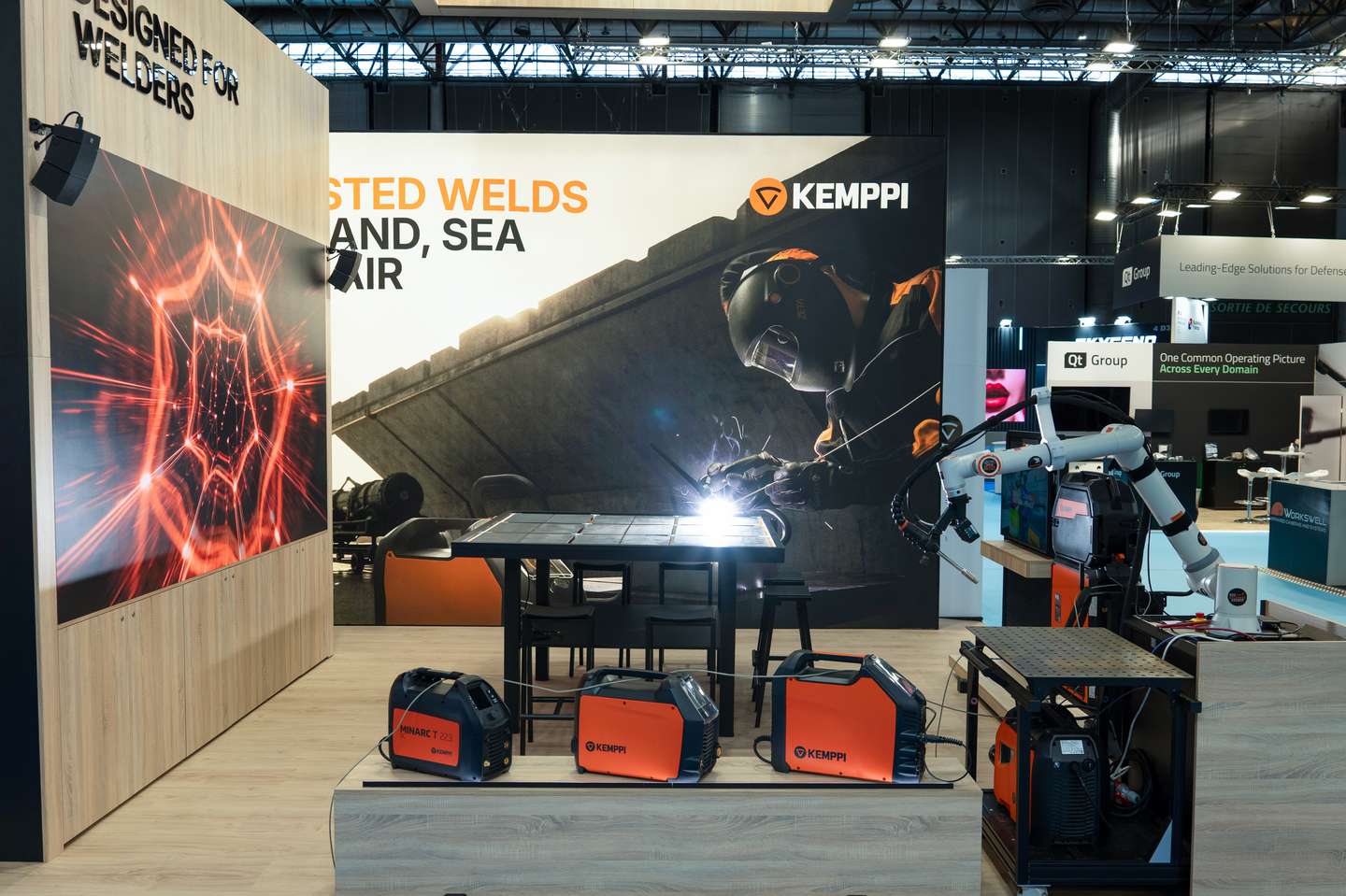
Eurosatory 2026 And the Future of Defence Manufacturing
Eurosatory 2026 highlighted a clear shift in modern defence manufacturing. While defence systems are becoming more digital, networked, and autonomous, their foundation remains physical. From armoured vehicles and artillery to industrial resilience, welding quality, steel structures, and production discipline remain paramount to defence readiness.
Digitalization, Innovation