Welding ABC
How to Avoid the Most Common MIG/MAG Welding Defects
February 15, 2021
The quality requirements in welding production increase with the optimization of structures as well as the development of materials and welding processes. Welding defects can, at worst, cause serious accidents and structural damage, so it is important to avoid them and understand the mechanisms that create them. In this text, we present the most common MIG/MAG welding defects and the ways to best avoid them.
Reetta Verho
Welding quality assurance is a holistic job. High-quality welding operations are guaranteed by professional personnel, welding procedure specifications (WPS) and work instructions, and inspection activities. All areas must be in good condition for high-quality welds to emerge.
In the Finnish welding terminology standard SFS 3052, a welding defect is defined as “a discontinuity in the weld or deviation in the form of a weld. Welding defects include cracks, lack of penetration, porosity, and slag inclusion.” Moreover, the international standard ISO 6520-1 classifying and describing weld imperfections states a welding defect being “a discontinuity in the weld or deviation from the assumed geometry of the weld.”
What are the most common MIG/MAG welding defects?
The most common welding defects in MIG/MAG welding include e.g. porosity, inclusions, undercut, excessive asymmetry of fillet welds, lack of penetration, and spatters. Perhaps the most typical ones with the MIG/MAG welding process are spatters and lack of fusion. Each welding defect has its own reasons of origin that the welder must know in order to be able to avoid their creation.
Below are a few examples of typical MIG/MAG welding defects and how to prevent them from happening.
Lack of fusion
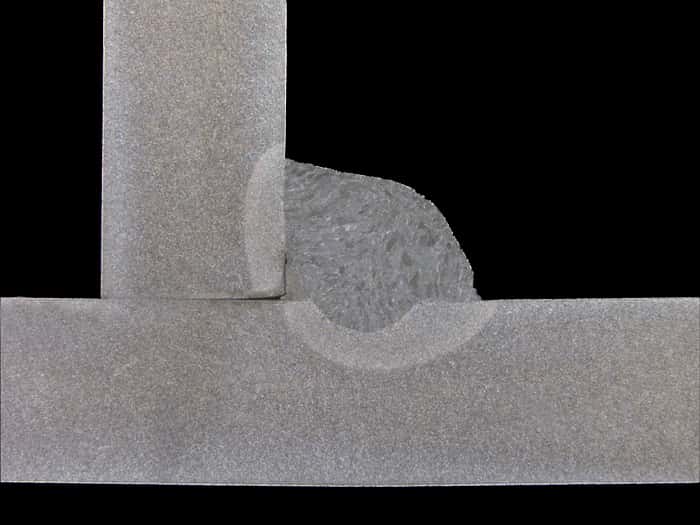
Reasons | Prevention method |
|---|---|
Too narrow joint preparation | Ensure that the joint preparation is sufficiently wide |
Incorrect gun angle | Make sure the gun angle will produce adequate side-wall fusion |
Excessively high current or too low a welding speed, which creates weld pool flooding ahead of the arc, resulting in insufficient penetration | Select welding parameters (high welding current, short arc length, and not too high a welding speed) that promote sufficient penetration without causing flooding |
Impurities on the joint faces | Clean the joint faces |
‘Downhill welding’ | Use vertical up welding |
Too long arc / too high voltage | Use shorter arc / less voltage |
Too low heat input | Increase heat input |
Excessive fillet weld asymmetry
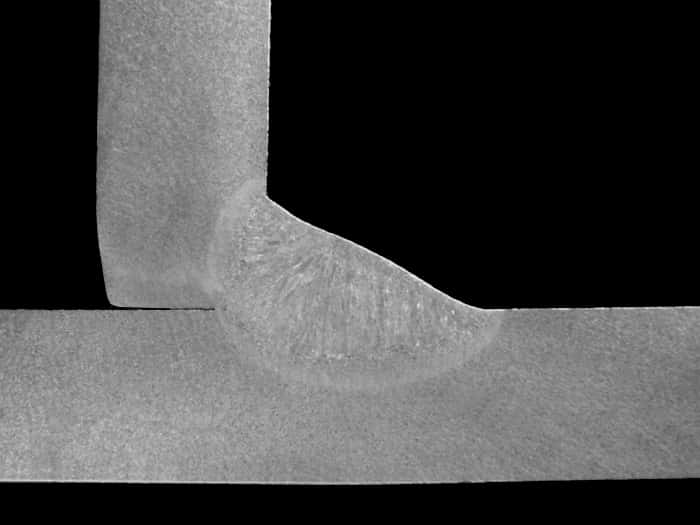
Reasons | Prevention method |
|---|---|
Incorrect gun angle | Use the correct gun angles |
Too large a weld pool | Reduce the deposition rate |
Magnetic arc blow | Move the earth return clamp, use the shortest arc possible, reduce the welding current, angle the gun opposite the direction of arc blow, and/or use an AC power source |
The welding defect limits are specified for each weld class in ISO 5817. In this standard, the limits are classified into three weld classes, namely grade B, C and D. In the mechanical engineering industry, the typical grade is grade C, but grade B is also often required in much more demanding welding production. The welding defects are presented in the standard as actual measurements. The detection and interpretation of these values may require a destructive testing method alongside visual inspection.
Avoid welding defects to improve welding quality
Welding defects should be avoided simply because they require repair. All welding-related repair work in the production floor require time and therefore money. This will slow down production progress, and eventually delays in project schedules. However, the most unpleasant consequence of welding defects can at worst be a product or a structure breaking down, which can lead to various accidents and even personal injury.
We can detect welding defects by inspecting the welds, but at that time it is already late and the product has to be repaired. Welding production must be developed in the right direction in order to reduce the risk of welding defects. Such development measures may include, for example, tightening the quality requirements for groove preparation, changing the welding process, or changing the parameters. However, the training of welders is particularly important. The qualification of welders plays a very central role in quality improvement work.
Visual inspection and production monitoring in a key role
The most important method of welding inspection is visual inspection. Every welder should therefore also act as an inspector of their own work. Good results have been achieved in welding production when visual inspection training has been provided for welders. Often, even with such small measures, the quality of welds can be significantly improved.
Real-time production monitoring also plays a key role in preventing welding defects. Kemppi’s WeldEye software enables easy monitoring of welding production, as it automatically checks, for example, whether the welder is qualified for welding the product in question and that the qualification certificate has not expired. The software can also be used to monitor welding parameters and NDT inspections. At best, real-time monitoring of welding production can prevent welding defects from happening, and make it easier to find the cause of detected defects.

Reetta Verho
Reetta Verho
Manager, Welding Services at Kemppi Oy. International Welding Engineer (IWE) who is an active member in ISO standardization committees. Board member in The Welding Society of Finland. Passionate about welding quality and the development of welding production. Member of: K105 National mirror committee for welding, ISO/TC44/SC10 Quality management in the field of welding ISO/TC44/SC11 Qualification requirements for welding and allied processes personnel.
Related products
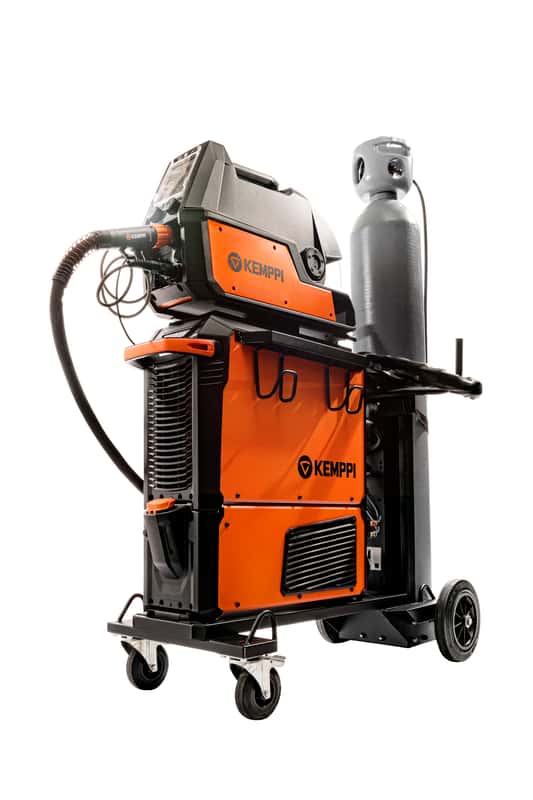
Product family
The 360-degree modular multi-process welder primarily focuses on high-performance MIG/MAG welding. X5 FastMig offers setup options for manual, synergic, and pulse welding. A wide range of accessories brings flexibility and efficiency to welding production processes.
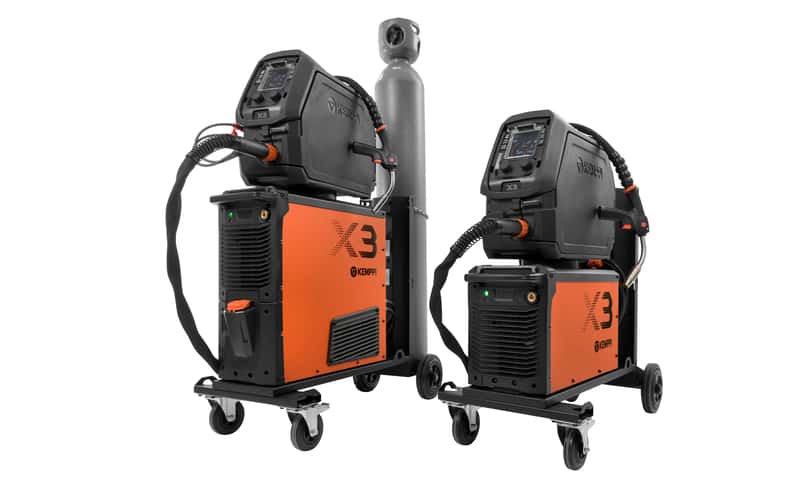
Product family
The X3 FastMig offers high-quality industrial MIG/MAG welding with straightforward operation and an extremely simple user interface. The synergic power source delivers 420 A, and the pulse power source 450 A at a 60% duty cycle.
More blog posts
Calculation of heat input in MIG/MAG welding
The new welding procedure test standard, EN-ISO 15614-1:2017, provides recommendations for the measurement and calculation of heat input. In concrete terms, what does this mean for MIG/MAG welding? And how can workshops carry out these calculations in practice?
Welding ABC
Welding value with X5 FastMig
Small improvements in welding efficiency can positively influence overall productivity and establish valuable cost savings. By investing in robust, reliable, and versatile equipment, you can improve and better manage welding project costs.
Manual welding

WeldEye enables remote work in welding production
Managing welding production with a cloud-based software solution has considerable advantages. For one, it gives work supervisors or quality assurance teams the convenience of working remotely from home. It increases transparency, quality and efficiency, thanks to improved information flow and traceability. The welders also receive immediate feedback on their work.
Digitalization
How Rapid Welding and Kemppi Built a Partnership That Lasts
Rapid Welding has worked with Kemppi since the company opened in 1990. Co-founder and Managing Director Roy Edwards highlighted the principles behind that 36-year partnership, from choosing the right welding solution and supporting equipment throughout its life to addressing the skills shortage and finding the right place for automation and laser welding.
Welding automation, Manual welding, Welding ABC
Safety that keeps up with welders' challenges and changing risks
Welding safety has become increasingly demanding. The hazards at the arc remain constant, but modern working conditions mean exposure can accumulate over longer shifts and in tighter indoor spaces. As a result, welding PPE needs to be treated as both protection for the welder and proof of compliance. At Kemppi, welding safety PPE is designed and validated in practice through clear requirements, welder-led feedback, and verified compliance with EU PPE Regulation 2016/425, CE marking processes, and relevant EN standards.
Safety, Welding ABC
Eurosatory 2026 And the Future of Defence Manufacturing
Eurosatory 2026 highlighted a clear shift in modern defence manufacturing. While defence systems are becoming more digital, networked, and autonomous, their foundation remains physical. From armoured vehicles and artillery to industrial resilience, welding quality, steel structures, and production discipline remain paramount to defence readiness.
Digitalization, Innovation